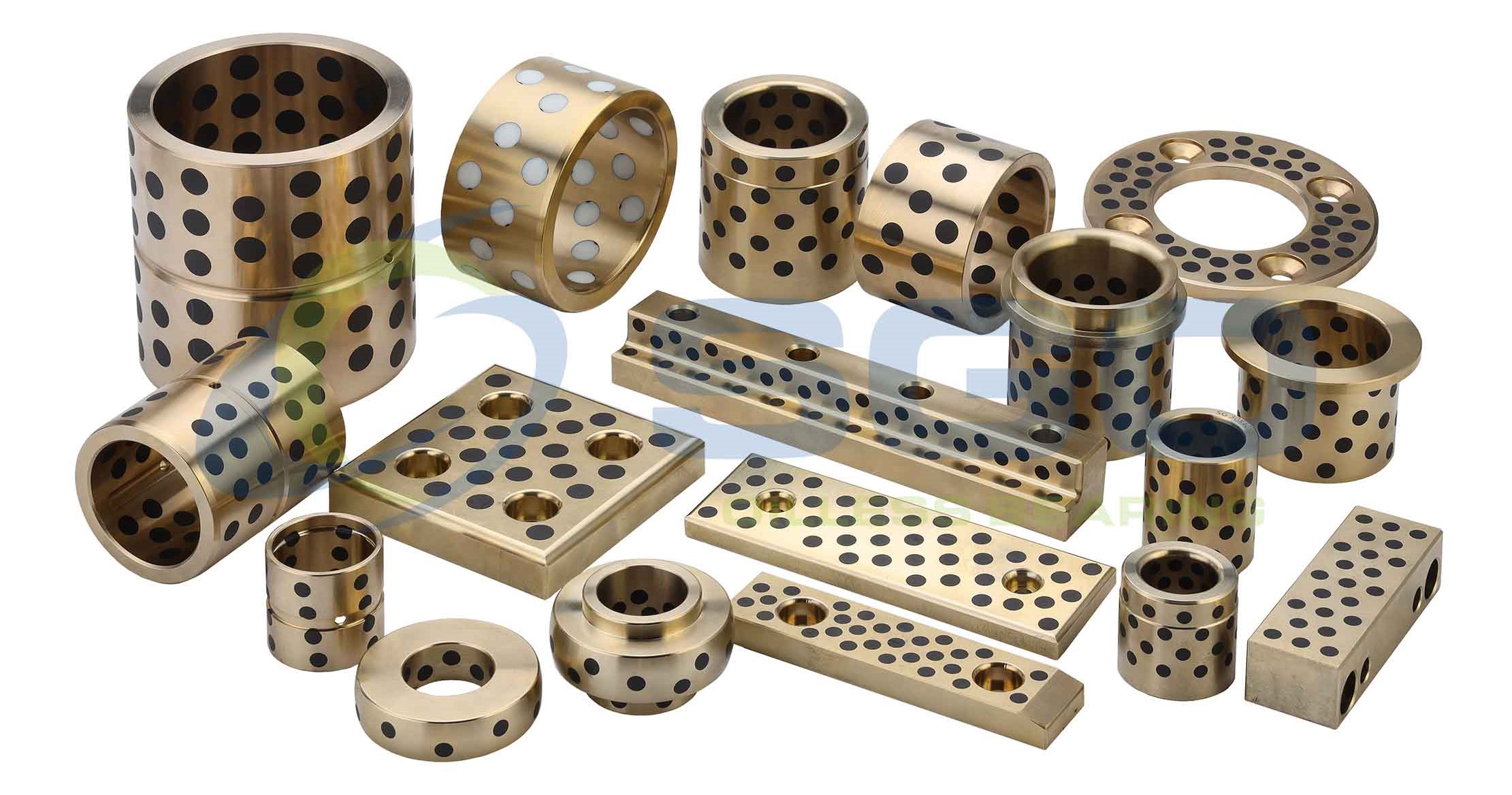
Long-Lasting Oilless Bearings
What Causes Premature Wear? 🤔 |
|
|
Oilless bearings require no additional lubrication and offer excellent wear resistance, making them widely used across various industrial applications. However, even highly durable bearings can wear out sooner than expected if they are used under unsuitable operating conditions or installed incorrectly.
|
|
|
If bearings require frequent replacement or the equipment produces unusual noise and vibration, it is important to check the installation and operating conditions rather than attributing the problem solely to the service life of the bearing itself.
|
|
|
In this newsletter, we will explore five common factors that can shorten the service life of oilless bearings.
|
|
|
1) Improper Surface Condition of the Mating Shaft
|
|
|
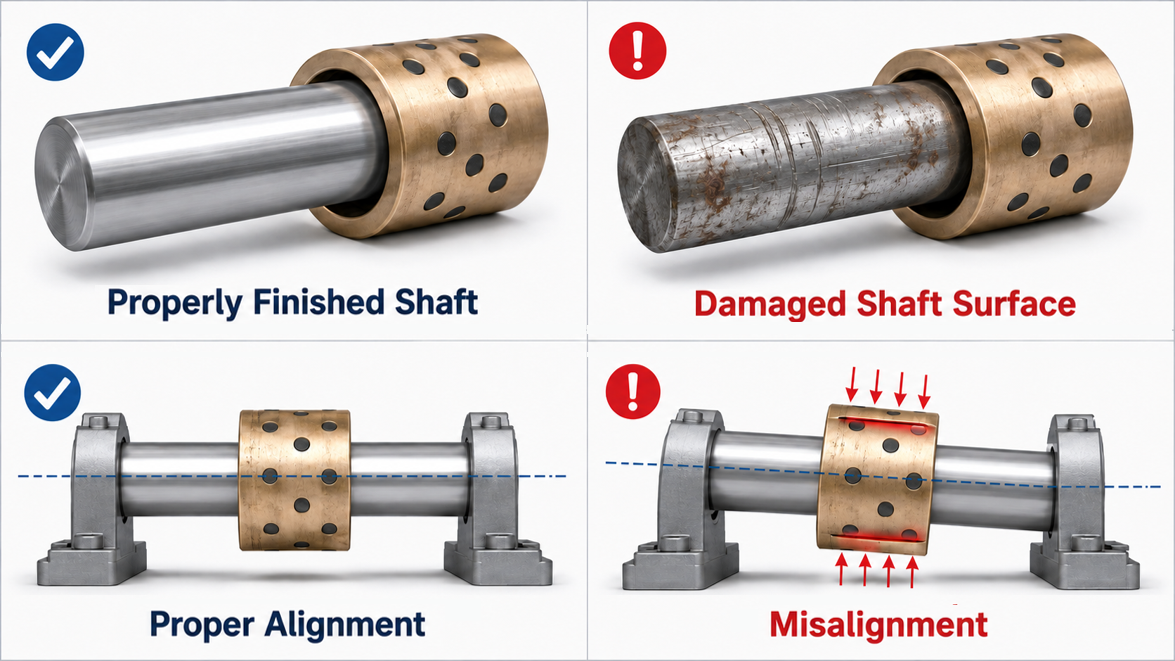
Poor mating shaft surface conditions can significantly shorten bearing life. |
|
|
If the shaft surface is excessively rough, it can continuously scrape against the bearing’s contact surface and accelerate wear. Scratches, rust, or machining marks on the shaft can also cause friction to become concentrated in specific areas. |
|
|
In addition, if the hardness of the mating shaft is incompatible with the bearing material, both the shaft and the bearing may be damaged. Therefore, when replacing a bearing, check the mating shaft for scratches and rust, bending or deformation, compliance with the recommended surface roughness, and compatibility of its material and hardness with the bearing. |
|
|
If wear repeatedly occurs in the same area even after a new bearing has been installed, the condition of the mating shaft should be inspected. |
|
|
2) Misalignment Between the Shaft and Bearing
|
|
|
If the shaft and bearing are not properly aligned, the load will not be distributed evenly across the bearing. |
|
|
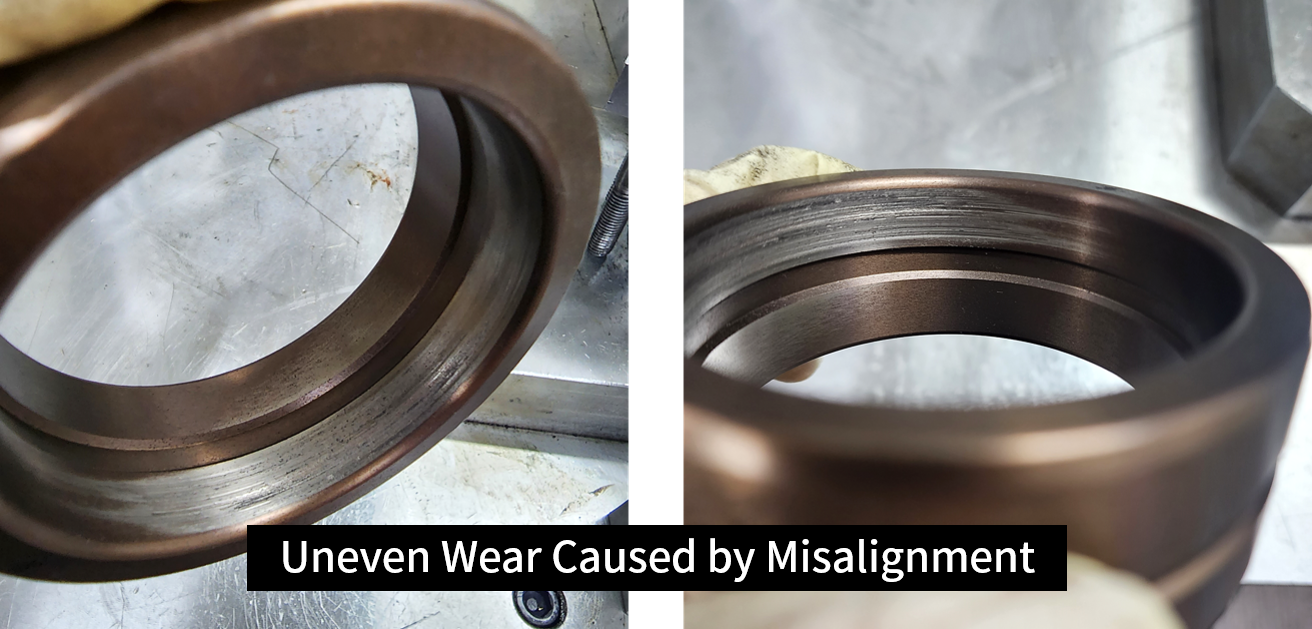
As a result, the load may become concentrated on one side, causing uneven wear as well as noise, vibration, or abnormal heat generation during operation. In equipment with a long shaft or multiple bearings, even minor alignment errors can accumulate and lead to more serious problems. |
|
|
Therefore, if one side of the bearing is noticeably more worn or shows diagonal wear marks, check whether the shaft and housing are properly aligned and whether the mounting surface is tilted. |
|
|
The shaft should also be inspected for bending or wobbling, and when multiple bearings are used, the centerlines of all bearings should be checked to ensure that they are properly aligned. |
|
|
Proper alignment is essential not only for extending bearing life but also for ensuring the stable operation of the entire system. |
|
|
3) Selecting a Bearing That Is Unsuitable for the Operating Conditions
|
|
|
Oilless bearings vary by product in terms of load capacity, operating speed, temperature range, and suitable type of motion.
|
|
|
For example, a bearing designed for rotational motion may wear rapidly when used for repeated oscillating motion or under heavy loads. Conversely, selecting a product with specifications that far exceed the actual operating requirements can result in unnecessary costs.
|
|
|
Therefore, the following operating conditions should be carefully considered when selecting a bearing.
|
|
|
✅ Load applied to the bearing
✅ Rotational and linear speed of the shaft
✅ Type of motion, such as rotational, reciprocating, or oscillating motion
✅ Continuous or intermittent operation
✅ Actual operating temperature
✅ Environmental conditions, including exposure to water, dust, or chemicals |
|
|
Rather than selecting a bearing based solely on its dimensions, it is important to choose a product that is suitable for the equipment’s overall operating conditions.
|
|
|
4) Contamination by Dust or Foreign Particles
|
|
|
f foreign particles such as metal debris, sand, or dust enter between the bearing and the shaft, they can act as abrasives and damage the contact surfaces. Particularly in dusty working environments, even fine particles can scratch the inside of the bearing during repeated operation, increasing friction and wear. If moisture or chemicals also enter the bearing, they may cause corrosion, making careful maintenance even more important. |
|
|
To prevent this, thoroughly clean the shaft and housing before installation and ensure that metal debris or dust does not enter during assembly. Depending on the operating environment, seals or covers should be installed to prevent contaminants from entering, and the area around the bearing should be regularly inspected for contamination. |
|
|
In environments exposed to moisture or chemicals, bearings made from materials suitable for those conditions should be selected. In highly contaminated environments, both the wear resistance of the bearing and the equipment design for minimizing contaminant ingress should be considered to ensure more reliable bearing operation. |
|
|
5) Improper Installation and Incorrect Clearance
|
|
|
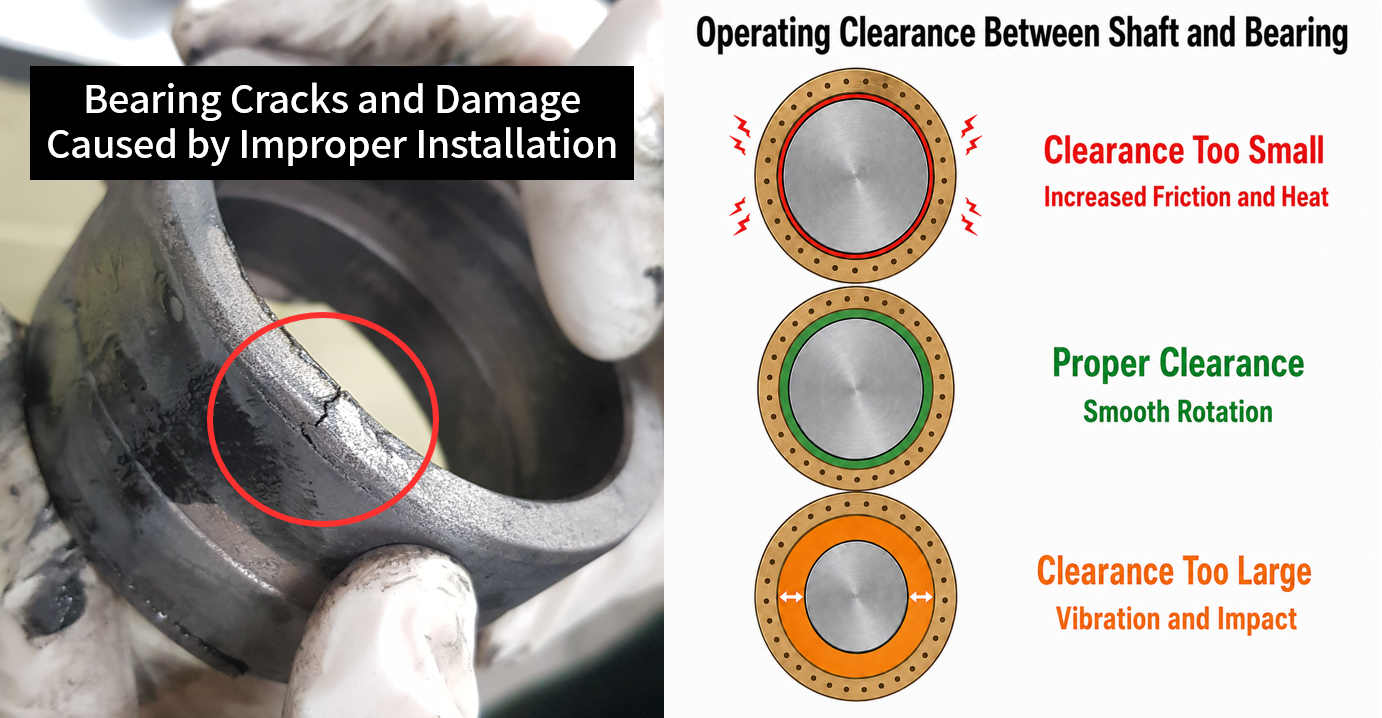
Applying excessive force or using unsuitable tools during installation can deform or damage the bearing. |
|
|
In particular, the inner diameter of a press-fit bearing may decrease after it is inserted into the housing, so checking its dimensions only before installation is not sufficient. If the clearance between the shaft and bearing is too small, friction and heat generation will increase; if it is too large, looseness and impact may accelerate wear. |
|
|
Therefore, the following points should be checked during installation. |
|
|
✅ Recommended tolerance between the bearing and housing
✅ Actual inner diameter of the bearing after press-fitting
✅ Operating clearance between the shaft and bearing
✅ Any distortion or deformation caused during installation
✅ Smooth movement between the shaft and bearing |
|
|
Striking the bearing directly with a hammer or press-fitting it at an angle may damage the product. Always use the appropriate installation tools and apply force evenly across the entire bearing. |
|
|
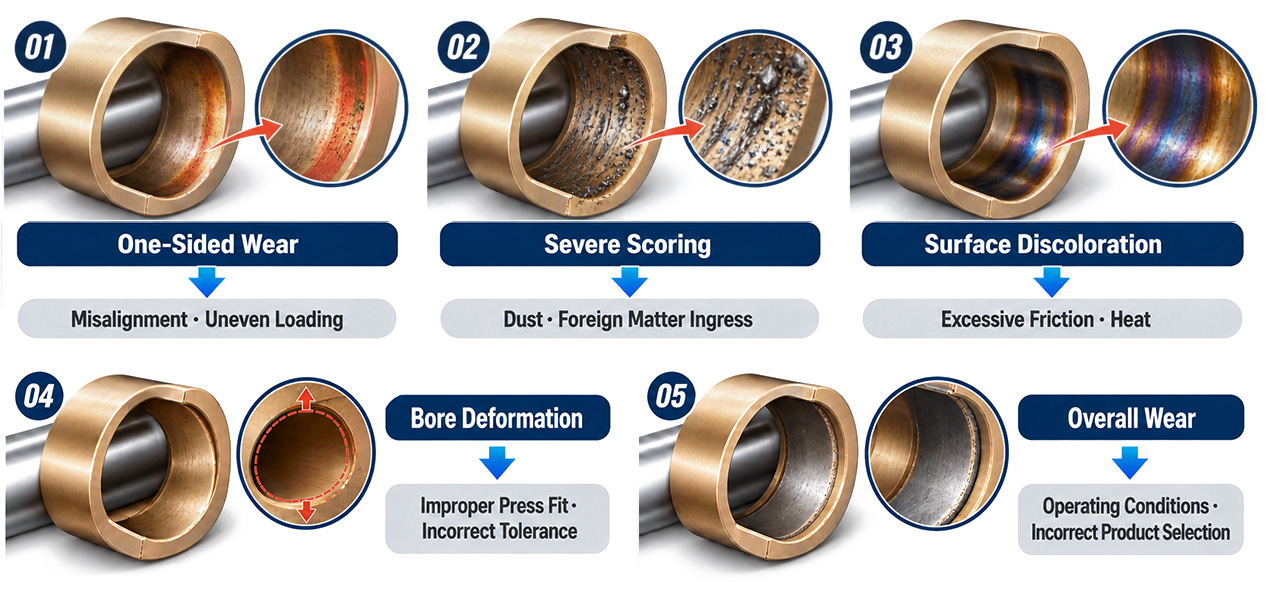
🔎 Wear Patterns Can Help Identify the Cause |
|
|
If a bearing is worn, examine the pattern and location of the wear before disposing of it. |
|
|
Wear marks can provide important clues about problems occurring within the equipment. |
|
|
Extend Bearing Life by Considering Everything
from Product Selection to Installation!
|
|
|
The service life of an oilless bearing is not determined solely by the performance of the product itself. |
|
|
Stable bearing performance depends on various factors, including operating load and speed, the condition of the mating shaft, alignment, the surrounding environment, and the installation method. |
|
|
If bearings repeatedly become damaged in the same location or you are unsure which product to choose, please contact SGO. Let us know your operating environment and required specifications, and we will help you select the right oilless bearing for your application. 😊 |
|
|
In today’s newsletter, we explored the main reasons why oilless bearings may wear out sooner than expected. We will be back with more practical bearing information that you can use in the field. 🙇♂️ |
|
|
SGO CO.,LTD. ㅣ info@sgoilless.co.kr
28-10, Namdongseo-ro 113beon-gil, Namdong-gu, Incheon, Korea
|
|
|
|
|